
Tech-Driven Disruption: What Businesses Should Expect
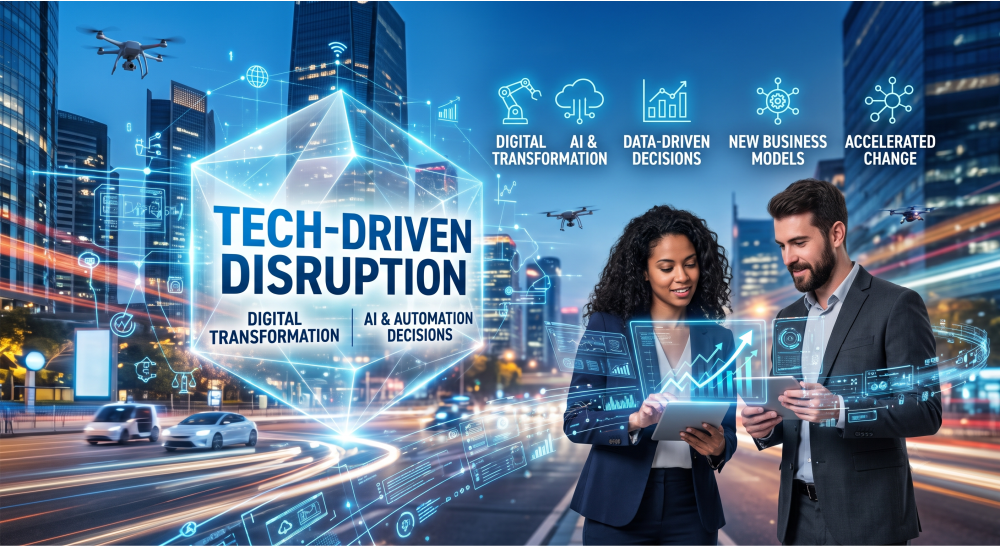
Technology is no longer just supporting business; it’s actively disrupting and redefining it. From AI-led automation to platform-based ecosystems, disruption is accelerating across industries like retail, healthcare, telecom, and financial services.
For businesses, the question is no longer “if” disruption will happen, but “how prepared are we?”
The New Reality of Tech-Driven Disruption
Organisations today are facing:
- Rapid shifts in customer expectations
- Emergence of digital-first competitors
- Increasing reliance on data and automation
- Constant evolution of business models and revenue streams
This disruption brings both opportunity and uncertainty, and navigating it requires a strong, adaptable technology foundation.
Key Challenges Businesses Should Expect
Most organisations recognise they need to transform. What trips them up is the complexity of actually doing it while running the business.
Legacy Systems as Anchors. Outdated infrastructure wasn’t built for integration with modern technologies. Monolithic systems resist modularity. Every change requires significant rework. The result: transformation becomes slow and expensive, killing momentum and morale. Meanwhile, competitors move at 10x speed.
Fragmented Technology Ecosystems: Few organisations have coherent technology strategies. Instead, they have accumulated systems—each solving an isolated problem, none communicating with others. Data lives in separate silos. Processes are disconnected. Customer views are fragmented. This technical fragmentation directly translates to poor customer experiences and operational inefficiency.
The Speed vs. Stability Paradox Innovation requires experimentation. Stability requires control. Most organisations treat these as opposing forces. Either they move slowly and carefully (and lose to faster competitors), or they move quickly and break things (and lose customer trust and operational reliability). The real challenge is building systems that enable both.
Data Overload Without Insights: Organisations are drowning in data but starving for insights. Raw volume doesn’t equal value. Without proper governance, analytics infrastructure, and decision-making frameworks, data becomes noise. Organisations need to transform data into actionable intelligence—and they don’t know how.
Cybersecurity & Compliance Complexity Increased digitisation means expanded attack surfaces. Regulatory requirements multiply. Organisations need to move fast without compromising security or compliance. This is exceptionally difficult, which is why many organisations simply slow down rather than solve for it properly.
These challenges aren’t siloed. They compound. Legacy systems make integration harder. Fragmented ecosystems make compliance more difficult. Data silos make insights harder to extract. Organisations trying to solve these individually fail because they’re deeply interconnected.
A Practical Roadmap to Navigate Disruption
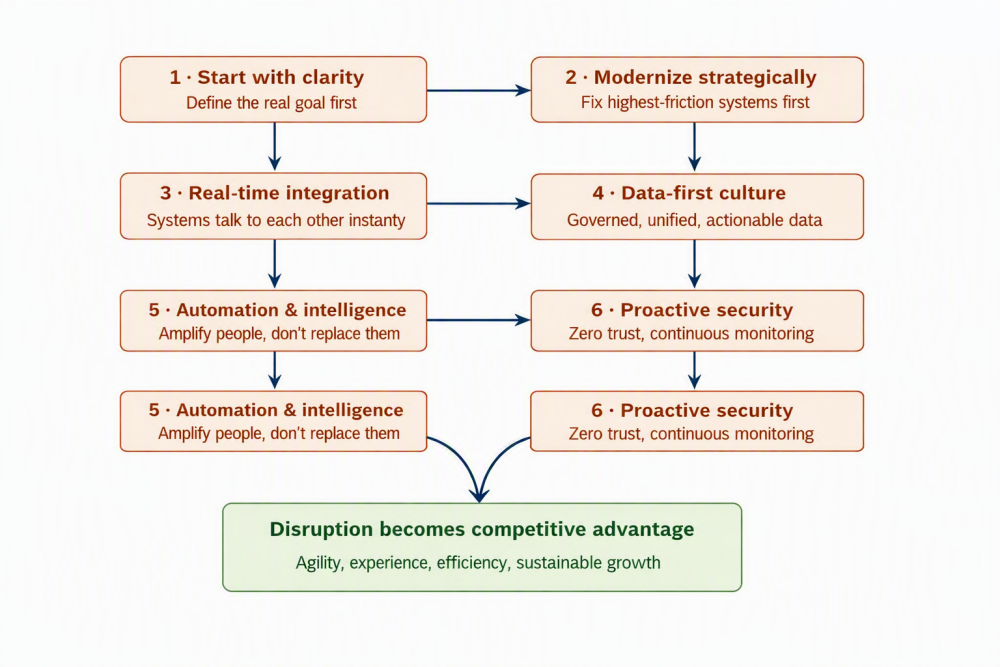
Start with Clarity
Before adopting new technologies, understand what you’re actually trying to accomplish. Are you trying to improve customer experience? Reduce operational costs? Enable new revenue streams? Create competitive differentiation? Each requires different technology choices and implementation approaches.
Modernize Strategically
Don’t rebuild everything. Identify which legacy systems create the most friction in your business model. Modernise those first—not because they’re technically interesting, but because they directly impact your ability to compete. Use APIs to connect old and new systems so they work together during transition.
Enable Real-Time Integration
API-led architecture is foundational. Modern systems need to talk to each other instantly. Customer data captured in one system should be immediately available in others. Inventory changes should update all channels simultaneously. Insights should flow to decision-makers in real-time. This requires intentional architecture—not an afterthought.
Build a Data-First Culture
Invest in centralised data platforms that unify information from disparate sources. Implement strong governance that balances accessibility with compliance. Deploy analytics and dashboards that make insights visible to those who need them. Most importantly: create a culture where decisions are grounded in data, not intuition.
Embed Automation & Intelligence
Automation handles routine tasks that don’t require judgment. AI enhances human decision-making through better information. Together, they create force multiplication—the same people accomplish more while focusing on higher-value work. The organisations winning this battle aren’t replacing humans. They’re amplifying them.
Proactive Security, Not Reactive
Zero Trust architecture means verifying every access request, every time. Continuous monitoring detects threats in real-time. Regular audits ensure compliance. This isn’t paranoia. It’s realism. The attacks are coming. The question is whether you’ll detect them in hours or weeks.
Business Benefits of Embracing Disruption
Increased agility and faster time-to-market: Modern systems enable you to respond to opportunities in weeks, not quarters. Feature rollouts that once required extensive testing now deploy continuously. Experimentation becomes normal.
Enhanced customer experience: Integrated platforms deliver personalised, seamless, consistent interactions across web, mobile, and physical channels. Customers feel understood. They get what they need when they need it. They stay longer and spend more.
Operational efficiency at scale: Automation handles routine work. AI optimises complex decisions. Humans focus on exceptions and strategy. The same team accomplishes 2-3x more while actually working less hard. That’s force multiplication.
Sustainable growth without proportional cost increases: Cloud-native architectures scale with demand. You pay for what you use. New markets don’t require rebuilding infrastructure. This changes unit economics in fundamental ways.
Competitive differentiation through speed and intelligence: Slower competitors can’t match your ability to innovate, personalise, or adapt. You win because you’re faster and smarter. This compounds over time.
The Real Challenge: Execution at Scale
While the roadmap may seem clear, execution is where most organisations struggle:
- Aligning business goals with technology investments
- Integrating legacy and modern systems
- Ensuring scalability, security, and compliance
- Maintaining continuity during transformation
This is where having the right technology partner becomes critical.
How Rite Technologies Can Help
At Rite Technologies, we help businesses turn disruption into opportunity by building robust, scalable, and future-ready technology ecosystems.
1. Strategic Consulting & Roadmapping
We evaluate your current landscape and design a clear transformation roadmap aligned with your business objectives.
2. End-to-End Integration Expertise
From POS systems and payment processors to healthcare platforms and mobility solutions, we specialise in creating connected ecosystems that eliminate silos.
3. Custom Development & Modernisation
We develop tailored solutions and modernise legacy systems to ensure flexibility, scalability, and performance.
4. Data & Analytics Enablement
Our solutions empower businesses with real-time insights, enabling smarter and faster decision-making.
5. Security, Compliance & Ongoing Support
We ensure your systems are secure, compliant, and continuously optimised to keep pace with evolving threats and technologies.
Tech-driven disruption is not a one-time event; it’s an ongoing shift that will continue to reshape industries over the next decade.
Businesses that succeed will be those that:
- Adapt quickly to change
- Invest in the right technologies
- Build integrated, scalable ecosystems
- Continuously innovate and optimise
With the right strategy and partner, disruption becomes less of a threat and more of a powerful catalyst for growth.
Rite Technologies helps organisations turn disruption into a competitive advantage. Let’s discuss your transformation roadmap.
MORE CASE STUDIES

Introduction to DevOps: Streamlining Software Development and Operations
Case StudiesIn today’s fast-paced digital landscape, software development isn’t just about writing code; it’s about delivering value quickly, reliably, and securely. That’s where DevOps comes in. DevOps is more than a buzzword. It’s a cultural and technical shift that...

How to Choose the Right Programming Language for Your Project
Case StudiesChoosing a programming language is like picking the right tool for surgery—it’s not just about what’s popular, it’s about what’s precise. Whether you're building a healthcare app, an automated inventory system, or AI-powered analytics, the language you...

The Role of Cybersecurity in Software Development: Best Practices and Strategies
Case StudiesIn today’s connected world, software isn’t just about functionality—it’s about trust. As cyber threats evolve in complexity, building secure applications isn’t a choice; it’s a responsibility. Cybersecurity must be embedded into the software development...

What Healthcare Leaders Should Know About Emerging Tech Trends
Case StudiesIn a rapidly evolving landscape, staying ahead isn’t just about embracing new technologies—it’s about understanding which innovations truly empower people. From artificial intelligence to virtual care and decentralized systems, today’s tech trends are...

The Human Side of AI: Ethical Innovation in Patient-Centered Design
Case StudiesAt Rite Technologies, we build more than algorithms—we build relationships. In a world increasingly shaped by artificial intelligence, we believe the future of healthcare isn't just smarter. It’s more human. This belief is stitched into every line of code,...