
How Emerging Technologies Are Redefining Business Models: The Imperative to Transform or Fade
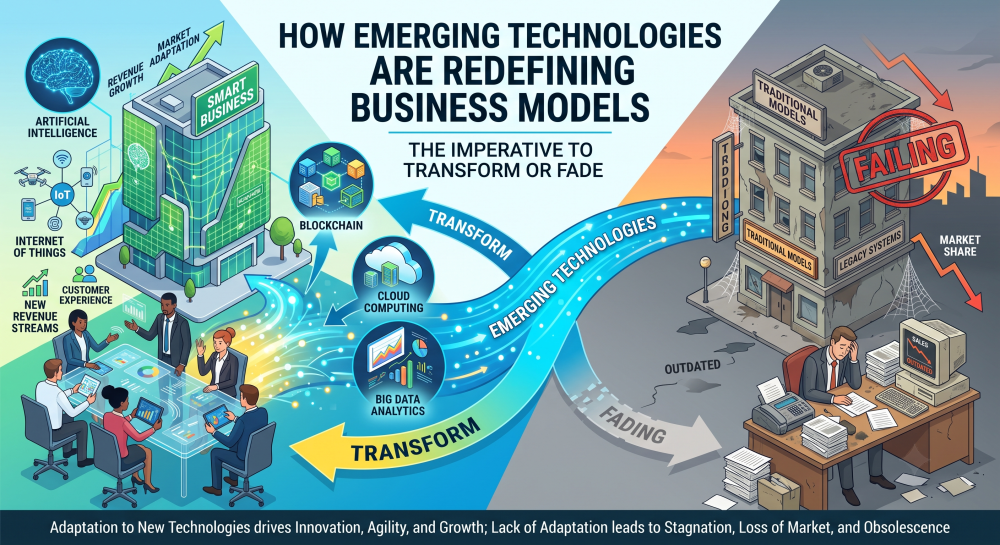
The Disruption Is Real—And It’s Not About Technology
Consider this: A decade ago, Blockbuster dominated the video rental industry with thousands of physical locations. Netflix was a curiosity. Today, the entire rental industry has vanished, and Netflix commands a global audience of hundreds of millions. The technology streaming was merely the tool. The real disruption was the business model.
This pattern repeats across industries. Uber didn’t just add technology to taxi services; it rewrote the rules of mobility. Airbnb didn’t optimise hotel operations; it created an entirely new category. Stripe didn’t improve payment processing; it democratized commerce.
Emerging technologies are not just tools for incremental improvement. They are fundamentally redefining how businesses operate, create value, and generate revenue. And for many organisations, the question is no longer whether to transform, but whether they can transform fast enough to survive.
The Great Shift: From Linear Models to Ecosystem Platforms
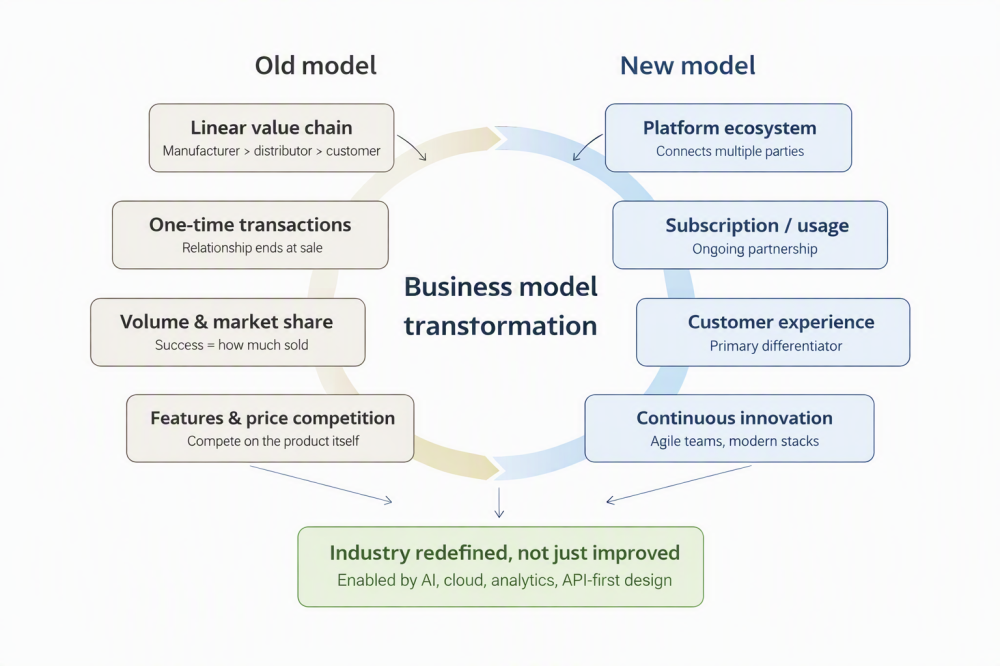
The Old Model Traditional business operations followed predictable patterns:
- Linear value chains where products flowed from manufacturer to distributor to customer
- One-time transactions that ended the relationship
- Success is measured by volume and market share
- Innovation driven by product features and price competition
- Decision-making based on historical data and executive intuition
The New Model. Forward-thinking organisations are operating from a fundamentally different blueprint:
- Platform-based ecosystems that create value by connecting multiple parties, not just selling products
- Subscription and usage-based models that shift from transactional relationships to ongoing partnerships
- Data-driven decision-making that replaces gut feel with real-time intelligence
- Customer-centric experiences that become the primary competitive differentiator
- Continuous innovation cycles enabled by agile teams and modern technology stacks
This shift is enabled by AI, cloud infrastructure, real-time analytics, and API-first architecture. Organisations that master these don’t just gain advantage, they redefine their entire industry.
The Hidden Complexity: Why Most Transformations Fail
Organisations attempting business model transformation face interconnected challenges:
Legacy System Constraints: Outdated infrastructure resists platform thinking. Systems built for linear processes can’t pivot quickly. The longer the transformation takes, the less valuable it becomes.
Fragmented Technology Ecosystems: Data silos prevent unified customer views. Disconnected processes frustrate employees. Building new business models on fragmented systems is like building a skyscraper on shifting sand.
Unclear ROI & Strategy Misalignment: Many organisations invest in emerging tech because it’s trendy, not strategic. Without an explicit connection to business model transformation, technology becomes an expensive distraction.
Data Complexity & Governance: Data is currency, but managing large volumes while ensuring compliance is genuinely difficult. Most organisations struggle with accuracy, accessibility, governance, or actionability—usually multiple simultaneously.
Skill Gaps & Change Management: Technical expertise is scarce. Cultural transformation toward data-driven decision-making is harder. Many organisations fail because they focus on technology, not people.
From Awareness to Action: A Practical Blueprint
Recognising that transformation is necessary is a starting point, not a solution. Organisations need a systematic approach to navigate from the current state to the future state without imploding in the process.
Phase 1: Modernise Incrementally
Replace systems one at a time, not all at once. Build modern components with APIs that coexist with legacy systems during transition. This reduces risk, maintains business continuity, and allows teams to learn and adapt.
Phase 2: Build a Connected Ecosystem
API-led architecture is foundational. Modern systems expose capabilities via APIs. Legacy systems are wrapped with adapters. Data flows between systems in real-time. This allows integrated function while gradually modernising components.
Phase 3: Pursue High-Impact Use Cases First
Focus on initiatives with clear business impact and rapid payoff: AI-driven customer segmentation, predictive maintenance, workflow automation, and real-time operational dashboards. Quick wins build confidence for larger initiatives.
Phase 4: Strengthen Data Foundations
Consolidate fragmented sources into unified platforms. Implement governance that balances accessibility with compliance. Build real-time analytics capabilities. Transform data into actionable intelligence.
Phase 5: Invest in People
Upskill teams in modern technologies. Restructure around customer outcomes, not legacy functions. Build a culture where data-driven decision-making becomes normal.
The Tangible Benefits: Why This Effort Matters
New Revenue Streams: Subscription and platform models unlock recurring revenue. Companies shifting to subscriptions report 40-60% improvement in customer lifetime value.
Enhanced Customer Experience: Unified data enables personalization at scale. Better satisfaction, lower churn, higher Net Promoter Scores.
Operational Efficiency: Automation and intelligent workflows reduce costs by 20-40% while improving quality.
Agility & Scalability: Cloud-native architectures enable rapid experimentation, geographic expansion, and resilience that grows with demand.
Data-Driven Competitive Advantage: Superior insights enable anticipating customer needs, optimising operations, and responding to change with confidence instead of guesswork.
The Execution Gap: Where Strategy Meets Reality
The execution gap appears in several forms:
Technology complexity without business clarity. Organisations invest in cloud platforms without clear strategies for how they’ll use them. They implement AI without understanding which decisions they want machines to make versus humans.
Business vision without technical roadmaps. Leadership decides to shift to a subscription model, but technical teams lack clarity on what systems need to change and in what sequence.
Disconnected initiatives without integrating principles. Teams work on modernisation, data, and customer experience independently, duplicating effort and missing synergies.
Measurement failure. Organisations launch initiatives but never establish clear metrics for success, making it impossible to course-correct or communicate value.
Change management afterthought. Technology is deployed, but people aren’t prepared to adopt it, leaving investments stranded.
Bridging the execution gap requires more than good intentions. It requires systematic thinking, experienced guidance, and disciplined implementation.
How Rite Technologies Bridges Strategy and Execution
We work with organisations that recognise transformation is necessary but are uncertain how to navigate the complexity. Our approach is grounded in practical experience across diverse industries and scenarios.
Technology Consulting & Strategic Roadmapping We assess your current business model, competitive position, and the model you’re shifting toward. We identify barriers and build a clear roadmap that sequences initiatives for maximum impact while aligning technical investments with business transformation.
End-to-End System Integration We specialise in building connected ecosystems across healthcare platforms, fintech, retail, POS systems, and mobility solutions. We architect systems where data flows freely, processes work seamlessly, and customer experiences feel integrated.
Custom Solution Development We design subscription and usage-based platforms, digital ecosystems, real-time analytics, and AI solutions tailored to your specific business model and competitive context.
Data & Analytics Enablement We consolidate fragmented data sources, implement governance frameworks, build real-time analytics, and deploy dashboards that transform data into actionable intelligence.
Continuous Optimisation & Partnership Transformation doesn’t end at implementation. We provide ongoing support, ensuring performance, compliance excellence, continuous innovation, and operational stability as your business scales new models.
Ready to chart your transformation path? Rite Technologies works with organisations to translate emerging technology trends into concrete business outcomes. Let’s discuss how we can help you move from vision to execution.
MORE CASE STUDIES

Tech-Driven Disruption: What Businesses Should Expect
Technology is no longer just supporting business; it’s actively disrupting and redefining it. From AI-led automation to platform-based ecosystems, disruption is accelerating across industries like retail, healthcare, telecom, and financial services. For businesses,...
Top Technology Trends Shaping the Next Decade: Strategic Imperatives for Digital Leaders
InsightsThe Era of Accelerated Innovation We stand at an inflexion point. The pace of technological change is no longer linear; it's exponential. Organisations that once dominated their markets through operational excellence alone are now competing against...

Exploring Microservices Architecture: Breaking Down Monolithic Applications
Case StudiesIn the age of agility, scalability, and continuous delivery, traditional monolithic applications often feel like digital dinosaurs, heavy, rigid, and hard to evolve. That’s why organizations across industries are embracing microservices architecture: a...

The Role of Artificial Intelligence in Automating Software Testing
Case StudiesIn the race to deliver faster, smarter, and more reliable software, testing often becomes the bottleneck. Manual testing is time-consuming, error-prone, and difficult to scale. Enter Artificial Intelligence (AI), a transformative force that’s reshaping how...

Harnessing the Power of Big Data in Software Solutions
Case StudiesIn today’s digital ecosystem, data isn’t just a byproduct; it’s a strategic asset. From predicting patient outcomes to detecting financial fraud, Big Data is transforming how software solutions deliver insight, efficiency, and impact. But harnessing Big...

Integrating Blockchain Technology into Software Applications
Case StudiesBlockchain is no longer just the backbone of cryptocurrency; it’s a transformative technology reshaping how software applications handle trust, transparency, and security. From securing patient records to streamlining financial transactions, blockchain...