
Insights
Top Technology Trends Shaping the Next Decade: Strategic Imperatives for Digital Leaders
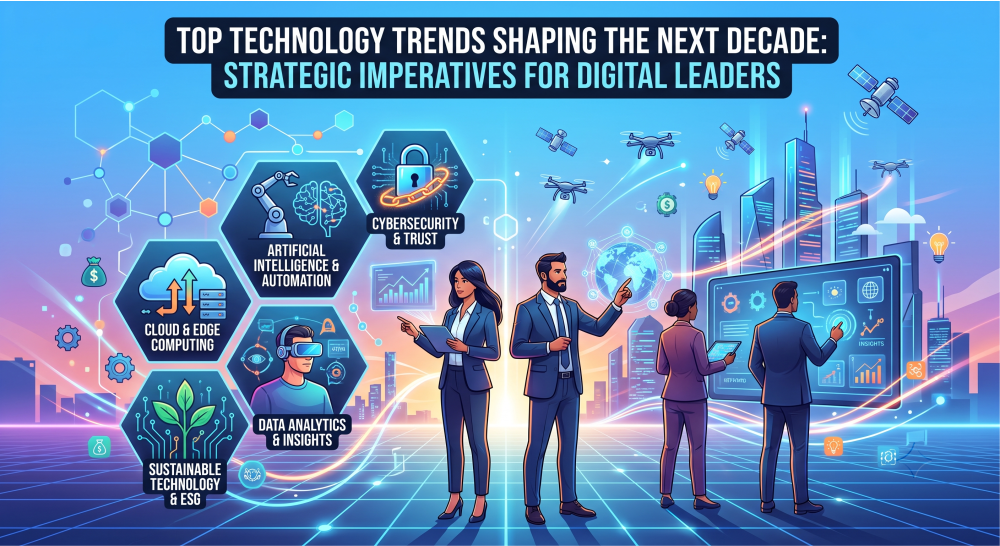
The Era of Accelerated Innovation
We stand at an inflexion point. The pace of technological change is no longer linear; it’s exponential. Organisations that once dominated their markets through operational excellence alone are now competing against digitally native disruptors. Yet in this landscape of constant disruption lies unprecedented opportunity.
The reality is stark: adopting emerging technologies is no longer optional. It’s foundational to survival and growth. Businesses across every industry, from healthcare to fintech, retail to telecom, are fundamentally rethinking their technology landscape. The question is no longer whether to innovate, but how to innovate strategically.
However, recognising these trends is only half the battle. The real challenge lies in understanding their nuances, addressing the barriers to adoption, and implementing solutions that deliver measurable, sustained value. This is where strategy meets execution.
Six Technology Trends Reshaping Business
1. Artificial Intelligence & Intelligent Automation
Where Digital Transforms Into Decision-Making
AI is no longer a future-focused experiment; it’s become table stakes. From automating routine processes to uncovering insights hidden in terabytes of data, AI is reshaping how businesses operate.
The Barriers Organisations stumble when they chase AI without purpose. Without a clear strategy and well-defined use cases, investments become expensive experiments. Additional challenges include fragmented data, legacy system constraints, and legitimate concerns about ethical governance.
The Path Forward: Success starts with specificity. Identify high-impact, achievable use cases aligned with business outcomes. Build robust data pipelines and governance frameworks. Deploy scalable models via API-driven architectures that integrate seamlessly with existing systems. Establish ethical guidelines upfront, transparency and accountability build stakeholder confidence.
The Payoff Organisations that get this right report 30-50% improvements in operational efficiency, faster data-driven decisions, enhanced customer personalization, and significantly reduced manual intervention costs.
2. Cloud-Native & Hybrid Infrastructure
Breaking Free From Constraints
The cloud has matured from buzzword to backbone. But migration isn’t plug-and-play. Many organisations find themselves trapped between legacy infrastructure and cloud aspirations, struggling with cost overruns, security concerns, and skill gaps.
The Barriers Poorly planned migrations lead to cost explosions. Organisations shift workloads to the cloud without a FinOps discipline, security becomes an afterthought, and teams lack the expertise to manage hybrid environments effectively.
The Path Forward: Phased migration strategies beat big-bang approaches. Implement rigorous FinOps practices from day one. Adopt hybrid or multi-cloud architectures that offer flexibility and competitive hedging. Invest in cloud-native security and DevSecOps practices that shift security left, embedding it into every stage of development.
The Payoff: Scalability on demand, faster deployment cycles, infrastructure costs that align with business consumption, and business continuity models that actually work.
3. Data-Driven Enterprises
Turning Information Into Competitive Advantage
Data is the new currency. Yet most organisations capture vastly more data than they can actionably use. Data silos, delayed insights, and weak governance create friction between data availability and decision-making.
The Barriers Legacy systems create isolated data islands. Real-time analytics remain out of reach. Poor governance means data quality suffers, and turning insights into action requires cross-functional alignment that many organisations lack.
The Path Forward: Unify data through enterprise integration layers and modern data platforms. Deploy real-time analytics and dashboards that make insights accessible, not hidden in quarterly reports. Establish strong governance frameworks that balance accessibility with compliance. Invest in predictive and prescriptive analytics that move beyond “what happened” to “what should happen next.”
The Payoff: Strategic decisions grounded in evidence, forecasting accuracy that reduces risk, deeply personalised customer experiences, and a competitive advantage that comes from seeing the market differently than rivals.
4. Cybersecurity & Data Privacy
Defending the Perimeter and Beyond
As organisations digitise more operations and store more sensitive data, the attack surface expands. Cyber threats are rising in frequency and sophistication. Regulatory requirements continue to multiply. Yet many organisations operate in reactive mode, responding only after breaches occur.
The Barriers Legacy security approaches assume trust. Endpoint vulnerabilities multiply. Regulatory complexity creates compliance headaches. Employee security awareness remains inconsistent.
The Path Forward: Adopt Zero Trust security frameworks that verify every access request, regardless of source. Implement continuous monitoring and threat detection that moves detection from reactive to proactive. Conduct regular audits and maintain compliance discipline. Invest in employee awareness—people are both your strongest defence and greatest vulnerability.
The Payoff: Dramatically reduced breach risk, customer trust that becomes a competitive differentiator, regulatory compliance that moves from burden to baseline, and resilience that ensures business continuity when threats emerge.
5. Digital Experience & Mobility
Meeting Customer Expectations Across Every Touchpoint
Customer expectations have fundamentally shifted. A fragmented experience across web, mobile, and in-person channels isn’t acceptable—it’s a liability. Organisations that deliver seamless, consistent experiences win customer loyalty and lifetime value.
The Barriers: Inconsistent user experiences across platforms confuse customers. Backend systems struggle to support omnichannel journeys. Integration complexity between front-end and legacy systems slows innovation. Customer preferences shift faster than organisations can adapt.
The Path Forward Design omnichannel strategies prioritise the customer journey over internal systems. Apply modern UI/UX design principles grounded in user research and usability testing. Use API-led integrations that decouple front-end innovation from back-end constraints. Build feedback loops that enable continuous iteration and improvement.
The Payoff: Higher customer engagement and interaction frequency, improved retention and lifetime value, strengthened brand perception, and seamless experiences that become competitive moats.
6. IoT & Connected Ecosystems
Real-Time Intelligence Across Physical and Digital Worlds
The Internet of Things is maturing. Organisations are deploying billions of connected devices across supply chains, manufacturing floors, healthcare facilities, and customer touchpoints. The challenge isn’t connectivity—it’s extracting meaningful intelligence and managing complexity at scale.
The Barriers Device heterogeneity creates integration complexity. Security concerns multiply as endpoints proliferate. Infrastructure costs can spiral with scale. Managing large deployments requires operational sophistication that many organisations lack.
The Path Forward: Standardise device communication protocols and secure data transmission frameworks upfront. Deploy scalable IoT platforms designed for growth, not point solutions. Leverage edge computing to process data locally, reducing latency and bandwidth constraints. Think of IoT not as device management, but as real-time intelligence infrastructure.
The Payoff: Real-time visibility across operations, measurable improvements in operational efficiency, predictive maintenance that reduces downtime, and automation that frees teams to focus on high-value work.
The Integration Imperative: Where Most Organizations Fall Short
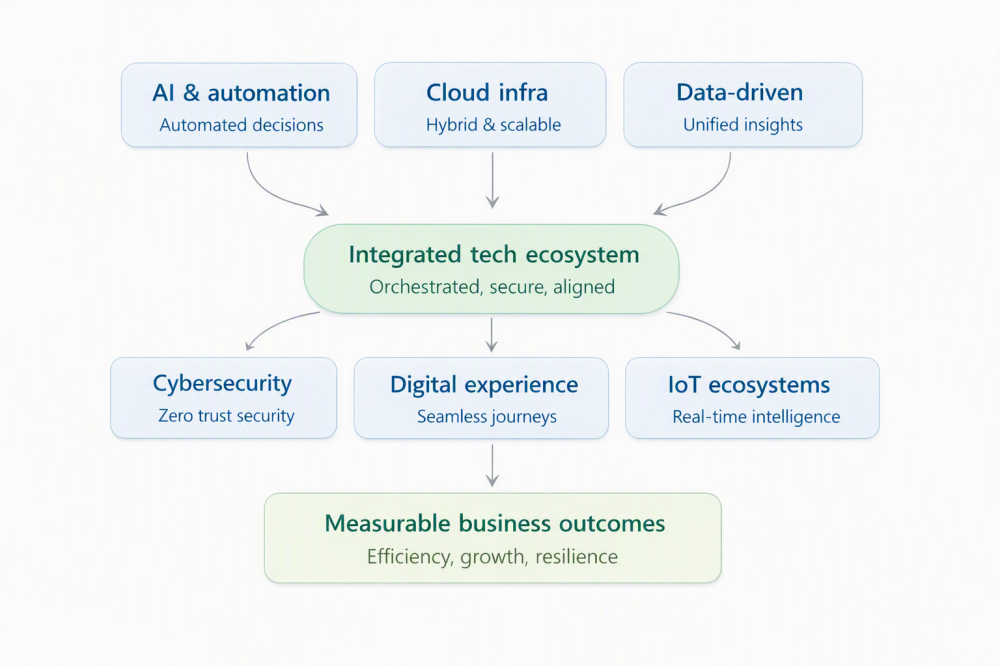
Individual trends are powerful. Combined? They’re transformative. Yet this is where most organisations struggle.
Many organisations operate in silos:
- Disconnected systems that don’t communicate, forcing manual data transfers and limiting real-time visibility
- Legacy infrastructure that constrains innovation and creates bottlenecks
- Lack of end-to-end visibility makes it impossible to optimise across the organisation
- Misalignment between business and IT, where technology investments don’t translate to business outcomes
The most forward-thinking organisations recognise that successful digital transformation isn’t about adopting individual technologies in isolation. It’s about orchestrating them into a cohesive ecosystem, one that’s secure, scalable, and aligned with business strategy.
How Rite Technologies Bridges the Gap
We’ve spent years helping organisations across healthcare, fintech, retail, and telecom navigate this complex landscape. We understand the tension between innovation velocity and operational stability. We know that transformation doesn’t happen overnight and that sustainable value requires both strategy and execution discipline.
Our Approach
- Consulting-First Mindset
We assess your current technology landscape, identify gaps between where you are and where you need to be, and define a roadmap aligned with your specific business objectives rather than generic best practices. - End-to-End Integration Expertise
From POS systems and payment processors to healthcare platforms and mobility solutions, we’ve built integrated ecosystems across industries. We understand the complexity of connecting legacy systems with modern platforms, and we know how to do it without disrupting ongoing operations. - Scalable & Future-Ready Solutions
Technology architecture is a long-term commitment. We design systems with flexibility in mind, architectures that are secure by design, scalable by nature, and ready to evolve as technologies mature and business needs shift. - Industry-Focused Experience
Domain expertise matters. We bring practical, battle-tested insights from healthcare compliance requirements, fintech security demands, retail omnichannel complexity, and telecom scale challenges. Theory is useful; experience is invaluable. - Long-Term Partnership Mentality
We measure success not by project completion, but by sustained value delivery. Our engagement model focuses on continuous optimisation, compliance excellence, and ongoing innovation ensuring your technology foundation grows stronger, not staler, over time.
The Path Forward
The next decade will belong to organisations that can do three things exceptionally well:
- Adapt quickly to emerging technologies and market shifts
- Integrate intelligently across disparate systems and data sources
- Innovate consistently without losing sight of operational excellence
While the challenges are real and the technology landscape is complex, the opportunities far outweigh the risks for organisations willing to approach transformation strategically.
The question isn’t whether your business will be shaped by these trends. It will. The question is whether you’ll be a leader in that transformation, or a reactive participant. Organisations that invest in the right technology foundation today, one that’s cohesive, secure, and business-aligned, will be the ones leading tomorrow.
The time to act is now.
Ready to build your digital strategy? Contact Rite Technologies to discuss how we can help you navigate the next decade of technological change.
MORE CASE STUDIES

Tech-Driven Disruption: What Businesses Should Expect
Technology is no longer just supporting business; it’s actively disrupting and redefining it. From AI-led automation to platform-based ecosystems, disruption is accelerating across industries like retail, healthcare, telecom, and financial services. For businesses,...
How Emerging Technologies Are Redefining Business Models: The Imperative to Transform or Fade
The Disruption Is Real—And It's Not About Technology Consider this: A decade ago, Blockbuster dominated the video rental industry with thousands of physical locations. Netflix was a curiosity. Today, the entire rental industry has vanished, and Netflix commands...

Exploring Microservices Architecture: Breaking Down Monolithic Applications
Case StudiesIn the age of agility, scalability, and continuous delivery, traditional monolithic applications often feel like digital dinosaurs, heavy, rigid, and hard to evolve. That’s why organizations across industries are embracing microservices architecture: a...

The Role of Artificial Intelligence in Automating Software Testing
Case StudiesIn the race to deliver faster, smarter, and more reliable software, testing often becomes the bottleneck. Manual testing is time-consuming, error-prone, and difficult to scale. Enter Artificial Intelligence (AI), a transformative force that’s reshaping how...

Harnessing the Power of Big Data in Software Solutions
Case StudiesIn today’s digital ecosystem, data isn’t just a byproduct; it’s a strategic asset. From predicting patient outcomes to detecting financial fraud, Big Data is transforming how software solutions deliver insight, efficiency, and impact. But harnessing Big...

Integrating Blockchain Technology into Software Applications
Case StudiesBlockchain is no longer just the backbone of cryptocurrency; it’s a transformative technology reshaping how software applications handle trust, transparency, and security. From securing patient records to streamlining financial transactions, blockchain...