
The Challenge
When we first connected with an early-stage software product company on a casual introductory call, their product was being shaped almost entirely by the developers building it—a common occurrence in early-stage product engineering. When asked who would actually use the product day-to-day and what their daily workflows looked like, the team lacked clarity on their target audience, risking misaligned features and low user adoption.
The Choice
Rather than immediately diving into building software features based on unverified assumptions, we challenged the brief. We proposed stepping back to run focused user discovery and product prioritization sprints first, helping the client’s leadership team map their true user base and align feature development with real-world user needs.
What We Built
We facilitated a structured UI/UX discovery and design sprint process:
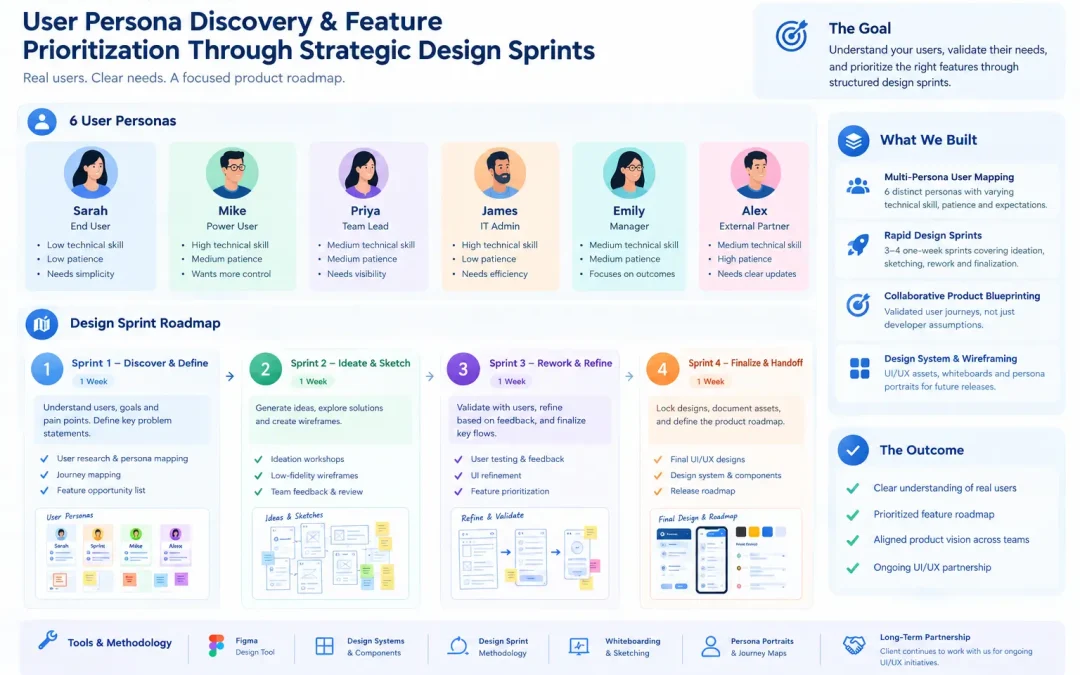
- Persona & Journey Mapping: Researched and established 6 distinct user personas across varying skill levels, patience thresholds, and expectations.
- Outcome-Driven Design Sprints: Led 3–4 one-week design sprints featuring collaborative whiteboarding, sketching, iterative feedback, and final journey approvals with active client team participation.
- Validated Product Roadmap: Re-prioritized product features to build a user-centric release schedule.
The Outcomes
- Tech Stack & Tools: Collaborative Design Tooling (Figma), Design Systems, Design Sprint Methodology, Whiteboarding, Wireframing & Sketching, Persona Portraits.
- Delivery Timeline: Executed across 3–4 one-week design sprints.
- Client Relationship & Partnership: The client continues to partner with us for ongoing UI/UX initiatives—reflecting Rite Technologies' long-term client trust, where most of our partners rely on us for between 5 and 10 years across their product lifecycles.
“Working with them was an absolute delight. Without any hesitation, I highly recommend them and would gladly introduce them to our network.”
— Chief Product Officer
The Handover
By shifting from developer-driven assumptions to a structured, user-centered product design strategy, the client gained total clarity on who their users were and what features to prioritize. The client continues to return to us for UI/UX work and frequently refers us across their executive network.
Tech Stack
Figma
Design Systems
Design Sprints
UI UX
Product Strategy
Persona Mapping
Feature Prioritization
User Research
Whiteboarding
If your product roadmap is currently driven by internal assumptions rather than validated user research,
let's execute structured design sprints.