
The Challenge
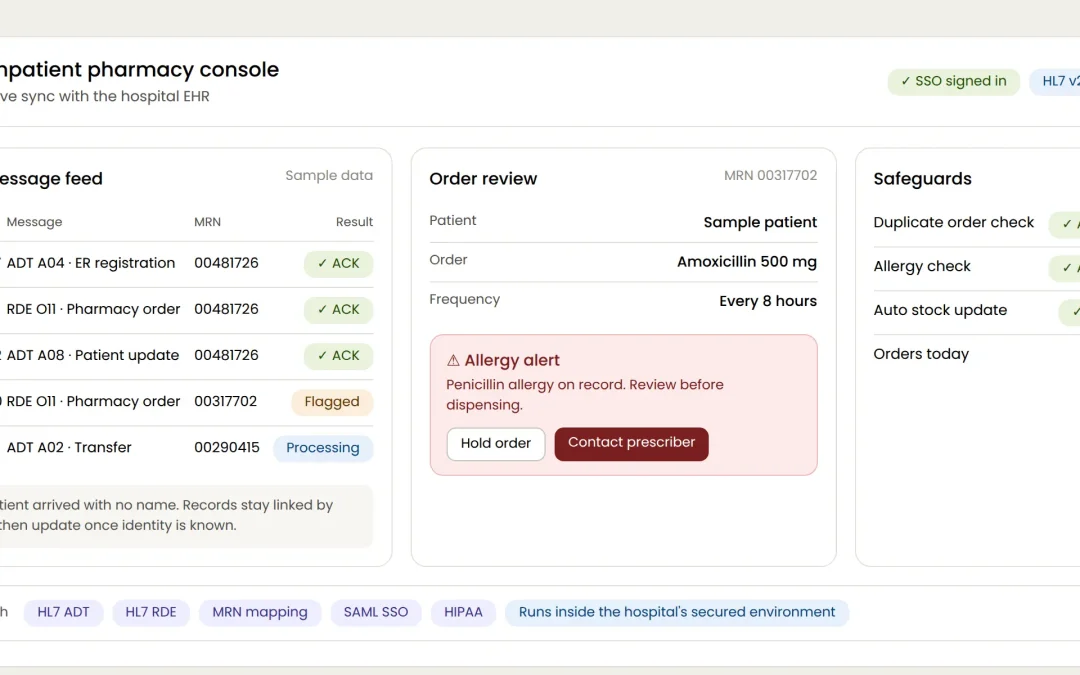
A major US hospital chain operated with its Electronic Health Record (EHR) system and inpatient pharmacies running on separate platforms. Disconnected systems created friction for pharmacy personnel—medication orders were delayed, records lacked synchronization, and emergency room scenarios where patients lacked immediate name details threatened to break data continuity across the care chain.
The Choice
Rather than forcing the hospital to adopt complex proprietary protocols, we chose to integrate using HL7 v2.3.1—the established standard already spoken by their enterprise infrastructure. Crucially, we anchored all patient identity logic to the Medical Record Number (MRN) rather than relying on patient names, ensuring data integrity remained intact during high-stress emergency arrivals.
What We Built
We engineered an enterprise-grade hospital pharmacy integration bridge:
- HL7 v2.3.1 Messaging Engine: Configured bidirectional ADT (admission, discharge, transfer) and RDE (pharmacy/treatment order) message pipelines to automatically synchronize patient files, orders, and fulfillment records.
- SAML Single Sign-On (SSO) Adapter: Extended the pharmacy platform to support the hospital’s enterprise SAML authentication, eliminating duplicate credentials and maintaining strict role-based access controls.
- Automated Clinical Safeguards: Built real-time checks that dynamically alert pharmacists to duplicate drug orders and patient allergies before dispensing.
The Outcomes
- Tech Stack & Interoperability: HL7 v2.3.x Messaging (ADT & RDE), MRN-Based Data Mapping Engine, SAML 2.0 Single Sign-On.
- Operational Scale: Processing 6,000 to 10,000 prescriptions daily across multiple inpatient pharmacy facilities.
- Governance & Security: Deployed entirely inside the hospital chain's secured environment under its native IT governance framework. Encryption scope, key handling, and data privacy remained fully controlled by the hospital with zero external data exposure.
- Long-Term Support Commitment: Stayed on long after go-live to investigate edge cases and refine real-time workflows—reflecting Rite Technologies' long-term partnership model, where most of our healthcare clients rely on us for between 5 and 10 years across their software ecosystems.
The Handover
By establishing a robust MRN-based HL7 pipeline and supporting the clinical team through go-live edge cases, we successfully unified the hospital chain's patient records and inpatient pharmacy operations with zero data loss.
Tech Stack
HL7 v2.3.1
HL7 ADT
HL7 RDE
MRN Mapping
SAML SSO
Inpatient Pharmacy
Hospital IT
EHR Integration
Healthcare Interoperability
HIPAA
If you need to integrate hospital enterprise systems with inpatient pharmacy workflows securely and reliably,
let's talk